The Giver
It's a great question: "Where DO they go? The ones who walk away from Omelas."
Ursula LeGuinn's short story "The Ones who Walk Away from Omelas" (which you may wish to read for comparison's sake) was clearly not written for children. However, it has a lot in common with Lois Lowry's incredibly popular (and often challenged) The Giver.
Both books challenge institutional thinking; both are deeply philosophical. The LeGuinn story is based on a notion that has challenged students in Ethics classes for generations: would it be better to live in a world where everybody suffered or in a world where nearly everyone thrived at the expense of a very few? In the case of LeGuinn's story, she's reduced the "few" to just one tormented child.
The "correct" answer is we'd NEVER allow the child to pay that price. The "true" answer is our world seems to depend on it. The philosophical argument is reduced to its absurd extreme; in reality, the one child is many children and adults from within our nation and around the globe.
In order for someone to have more, someone else must have less. Even in a Marxist society (if there ever could be such a thing), people would be discontent or feel cold or ache from hunger. Like the famous lifeboat problem (from the same Ethics class), if there isn't enough to support everybody in the lifeboat, everybody can die, or someone will have to be cut adrift.
There are no easy answers.
Some read LeGuinn's emigrating characters as morally indignant individuals who can not live with themselves if they know the child is suffering. So why don't they change the system? Why not just pull the child from the cellar, clean and feed and nurture him/her? The simple answer is, "You can't. It's one of the givens of the exercise." The real world is more complex than an ethical exercise. Some people DO oppose whale hunters and clear cutters and genetic engineers because they feel strongly that certain society needs to be changed. But change always comes with a cost. Keeping the dolphins out of the nets may mean more expensive or less plentiful tuna. Everybody sacrifices just a teeny bit. There are hundreds of thousands of teeny sacrifices, and, again, LeGuinn is rolling it up into a single change: if the child is released, the whole society will suffer. The exaggeration makes the issue come clear.
And when Jonas in The Giver releases the memories back into his society, there will be pandemonium (look at what happened the last time the receiver released just a fraction of the memories back). It is likely the community will be quarantined and, eventually, exterminated; the surrounding communities will not want to be infected with the ensuing chaos.
So the ones who can't stand the thought of the suffering child just leave; they look for somewhere better than Omelas. But is there such a place? LeGuinn may be describing the idealists of the world; she may also be describing those who are too weak to face up to responsibility and reality. The story does not have an easy ending; neither does The Giver.
Freedom, free will, independence--all are treasured (in theory). But The Giver does point out that it has its attendant price: allowing the community to introduce more children reminds him of the memory of hunger. Likewise, we can see that failing to release the elderly might have the same consequence. The community does not experience hunger. People have jobs. There's no vandalism, no drive-by shootings.
There is also no love (remember, "Precision of language"). The warmth of family gatherings, even the ability to choose (even see) color has vanished. Lowry, like LeGuinn, exaggerates to make a point--a stable society requires sacrifice and restriction.
Would anyone be willing to sacrifice freedom for safety and stability.
Most people do. Some more than others.
When I drive through southern Orange County (and it's just one of many such places), I find the unbroken chain of white, off-white, beige, off-beige tract homes (in three or four model styles per tract) dull. No one will paint a house Pepto-Bismol pink. That's probably a good thing! Who wants the neighborhood to be trashed by a Pepto-Bismol pink house? or tagging? or derelict trucks on the front lawns? Who wants to have to have the family duck behind the couch at night because a stray bullet might hit the children? So people leave the inner-cities, push further out into the tract houses of the west San Fernando Valley or east of Diamond Bar or south of Irvine and live in Association-controlled, gated, homogeneous communities. They trade freedom of expression and movement for safety.
Most people don't hide in gated communities. But people do pay taxes (for the common good); they obey laws which restrict freedom (again, for safety and the stability of the community). Most people would find a completely unrestricted society frightening. The Giver encourages readers to ask, "But where do we draw the line?"
Lowry doesn't answer the question. It's not her place to do so; she is trying to get the reader to think and choose (because, unlike the characters in the community, we can think and choose).
The Giver stays; he has, in the past at least, helped to keep the community stable. Jonas can't accept the cost--he treasures the ability to see red and the warm Christmas fire indoors after the bracing snow of the sled ride.
Is he heroic? Is he selfish? Is he making a change or just walking away from his responsibility?
Even the book's powerful ending is ambiguous. There is still a question that Jonas and Gabe die (though many readers just don't want to admit it), but how are we supposed to feel about that? When I discussed Andersen's "The Little Match Girl," I suggested you keep the ending of the fairy tale in mind when you read The Giver. I really think they have the same ending.
"But wait! Don't they appear in other books? Aren't there four in the series?
The answer is, "Well, sort of." With the incredible success of this book, Lowry moved on to the fantasy universe of Gathering Blue and the hinted at the return in the last two. Was that a money grab on her part? I have no way of knowing, but Gathering Blue is definitely a different story world, and prior to that Lowry refused to ask the question she was often asked by readers: "Do they die?"
another approach to The Giver
I always particpate in Banned Books Week on campus, and I've been asked to write more than one Banned Book of the Day essays. This last year the book was, yes, The Giver.
If you are interested, here is a link to the article
So Lowry's book is one that is among many that is both praised and villified, and there's a neat little shift to a related topic: censorship.
toss another book on the fire!
After the release (and massive popuarity of) the Harry Potter books in the U.S. a group of parents, fearing their children were going to transform into warlocks and witches, marched to El Dorado park in Long Beach where they cheered one another on as they tossed book after book on the fire to save their kids. It makes one wonder how we survived Wizards of Wavverly Place.
Book banning has always been a huge activity in the United States, regardless of what the first Amendment to The Constitution might say. But with a movement called New Realism, huge in the late 1960s (and no longer really new), it started gathering speed and intensity. Many point to a book by Paul Zindal called My Darling, My Hamburger, though others look back a couple of years prior to that at S.E. Hinton's The Outsiders. By the 70s book banning (and challenging) became humongous. Here's an example from when my daughter was three (she was not reading this at three, but I do love memories of my daughter being three).
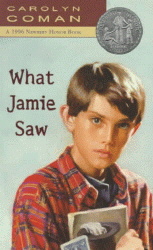
What Jamie Saw by Carolyn Coman was a Newbury Honor Book in 1996. The book deals with the very real subjects of child and spousal abuse and the effects they have on the entire family. From its opening line Coman's writing is lyrical and powerful:
"When Jamie saw him throw the baby, saw Van throw the little baby, saw Van throw his little sister Nin, when Jamie saw Van throw his baby sister Nin, then they moved."
The book has sparked some controversy.
Here is a review of the book on amazon.com:
What Jamie Saw, and what your children should never see May 1, 2000
Reviewer: A reader from Kanosh, Utah, USAWhat do you think, in real life, are the chances of a mother entering a room in the very same instance that her baby is being hurled through the air--and that mother being quick and agile enough to catch the baby before it hits the wall? In real life the baby would be dead. But what is even more unrealistic is for this book to carry a Newberry Honor award. What are we doing in letting a book on wife and child abuse slip into the hands of the very children we are trying to save from the savage actions of sick adults.
"What Jamie Saw," came to our school in a book fair. I bought fifty dollars worth of children's books that day, and "What Jamie Saw," was one of them. I finished the book then took it to the PTA president; she immediately pulled the book from the fair, and chucked them in the garbage where they belonged.
I encourage you, as Parents, to read this book so you can see for yourselves what type of literature (under the Newberry Award symbol) is being shoved in your childrens' faces.
"What Jamie Saw," is simply a book your children should never see.
--This text refers to the Hardcover edition.
The most telling part of the review is not that the parent found the material difficult, disturbing, objectionable, inappropriate for her child; parents brand books and music and television shows for whatever reasons every day. The most telling part is where she took the book "to the PTA president; she immediately pulled the book from the fair, and chucked them in the garbage where they belonged."
[my italics]
I recently asked a class of Freshman Composition students if they thought censorship existed in the United States today; many (over half) were positive: "NO! Not in the U.S.!"
They need to visit Kanosh, Utah.
or just about anywhere
Not too long ago the reading of "Little Red Riding Hood" was forbidden in one of the local school districts here in California. I mentioned this to the same class, and they wrestled with the "why" for a few minutes. They were surprised that the book was not banned because of its violence to animals and old women and little girls, not because a youngster was allowed to go off and talk to strangers in the woods (where were her parents?), not even because the wolf (in the Perrault version) invited Little Red to lie down beside him in bed. "Little Red Riding Hood" was banned because in the basket of goodies she brings to grandma there is a bottle of wine; it seems that Red is an "alcoholic enabler."
It's not a problem though. The UPDATED versions of the story (complete with sweet, Holly Hobbiesque, pastel drawings) have Little Red Riding Hood carrying cakes and cookies to grandma (I imagine they are low-cholesterol and with no processed sugar); when the wolf reaches the cottage he does not gobble up grandma but, instead, locks her in a closet; Little Red is also not eaten, only scared; finally, when the woodsman (why not a woodsperson?) arrives, he shoos the wolf away rather than chop him open with his axe (which should keep PETA content).
Books, especially children's books are challenged and/or banned often.
so what exactly is being banned? why?
The following link will take you to one page on banned children's books; do a search on the WEB, and you'll find a lot more:
Are you at all surprised that some of the books you were likely assigned in K-12 are there?
![[course schedule]](button31s.gif)
![[discussion questions]](button31q.gif)
![[lectures]](button31l.gif)
![[writing assignments]](button31p.gif)
![[readings]](button31r.gif)
![[home]](button31h.gif)