part 1: a very brief history of children's literature
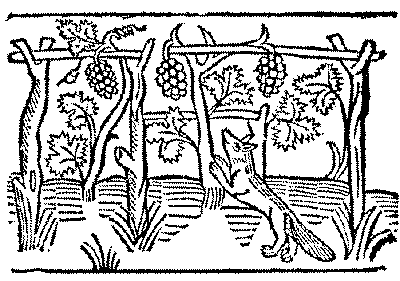
German woodcut from Aesop's Life and Fables
adapted from Wm. Caxton (1484)
In the beginning there really was NOT a children's literature. Arguably, children's literature is a relatively new phenomenon. But the earliest myths, legends, fables and tales are now dumped into the category of children's literature. There is nothing child-centered about a tale exploring the origins of the universe or the seasons or of the founding of a great civilization. These earliest stories were attempts for people to come to some understanding of life the universe and everything, to store some of their native wisdom and values, to record their history.
In the porquoi ("why?") tale "Why the Ant is Almost Cut in Two" the Kiowa explore a zoological phenomenon (the shape of the ant) and the larger natural realities of death and suffering. Perhaps some believed the story literally, most certainly the story can be read symbolically. In either case, contemporary adults are likely to dismiss the story as too fantastic with its talking ant and size-changing god Saynday who seems to want advice on how to run the universe. Still, this was not originally a children's story; most myths were not invented for children.
So why are they now read almost exclusively by children? Perhaps because they are generally primitive, fantastic (fantasy, unless it's in the form of a Tom Clancy or a Stephen King novel, is generally considered kids' stuff), child-like tales. Also, the story teaches a lesson, and literature that is overtly preachy or teachy (?) is generally given over to children who seem (to some) to need lots of teaching. Finally, kids just plain like these stories.
This brings us to two truths about children's literature:
Children's literature is didactic (teaches/preaches); even the best of children's literature is didactic.
Children acquire anything they like, whether it was designed for them or not.
To illustrate the first truth, one need only look at a few classic fables. The stories are delightful (I'm particularly fond of the Finnish sauna in "The Rooster and the Hen"), but clearly they are designed to teach; often the moral or lesson is included at the end of the fable (e.g. "It really does not pay to pretend to be what you are not"). These lessons are certainly true for adults, but the literature is reserved for children.
Excellent examples of the second truth appeared in the 17th and 18th centuries. Four books written for adults were among the most popular stories read by children (when they could get their hands on them): Cervantes' Don Quixote (1600s), Bunyan's Pilgrim's Progress (1678), Defoe's Robinson Crusoe (1719), and Swift's Gulliver's Travels (1726). Readers of this lecture will probably be able to recall "adult" books they read (by choice) as children :)
lets take a vote!
And where/when did children's literature as children's literature begin? I vote for the 18th century England, but there are some other reasonable candidates.
In the early 8th century Aldhelm (a religious leader, sometimes referred to as "the father of Anglo-Latin poetry") was said to have authored the first textbook (in Latin, of course) for children.
In the late 15th century (following the invention in the West of movable type), William Caxton, the first great English printer, printed Reynard the Fox (1481), The Fables of Aesop (1484), and Sir Thomas Malory's Le Morte D'Arthur (1484)--all classics enjoyed to this day by children.
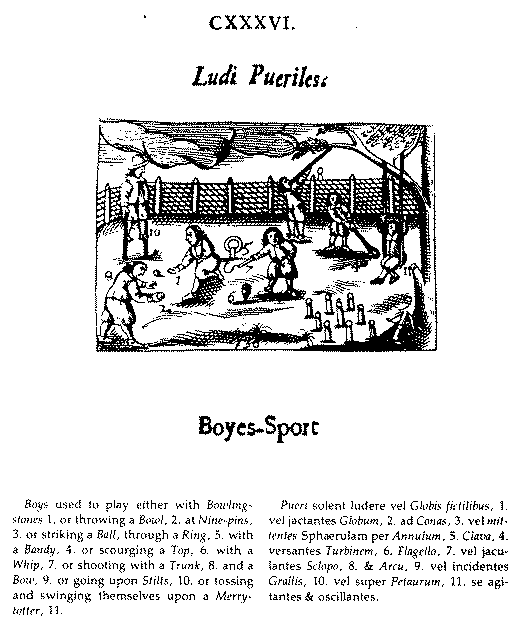
from Orbis Sensulium Pictus
by John Comenius (1658)
Johann Amos Comenius prodeced his Orbis Sensulium Pictus (1658 or 1659) which was a reference book for children, about children's subjects, in English! The opening epigram (taken from Latin) of the book reads, "Come along. I will show you everything. I will name all things to you." Comenius is often considered the earliest major figure in children's literature.
In the 17th and 18th centuries Puritans in England and America dominated thinking about the education of children. The first book published in America for children was John Cotton's Spiritual Milk for Boston Babes in Either England (1641, 1646). The purpose of the book was to teach the Bible, to guide behavior, to instill strict Puritan morals.
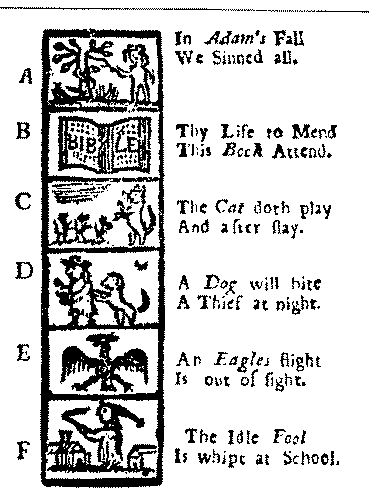
from The New England Primer
(this copy is from 1727)
The New England Primer (1683) was in use as a reading instruction text longer than any other text in American history; it included John Cotton's catechism.
In the Late 17th century Charles Perrault and Jean de la Fontaine (called (le fablier) produced tales (really for the French court).
where the Newbury Award comes from
Then in 1744 in England (remember my vote?) John Newbery settled in London and opened The Bible and Sun in St. Paul's churchyard. This was the first major press and bookstore specifically for children's books. He also signed several notable writers to produce children's books, and they were decently paid, AND THE BOOKS SOLD! Many see this as the defining event in the beginning of true children's literature. Two of his works more popular works were Little Pretty Pocket Book (1744) and Little Goody Two Shoes (possibly written by Oliver Goldsmith, 1765)--the first novel written for children.
By the 19th century things were hopping in England and America:
- Edward Lear's Book of Nonsense
- Frederich Hoffman's Struwwelpeter
- Lewis Carrol's Alice books
- Rudyard Kipling's Just so Stories
- Joel Chandler Harris's Uncle Remus Stories
- works by Robert L. Stevenson, George MacDonald, Washington Irving, Nathaniel Hawthorne
- illustrations by Randolph Caldecott, Kate Greenaway, Arthur Rackham, Sir John Tenniel, Walter Crane
And now, in the twentieth and twenty-first centuries?
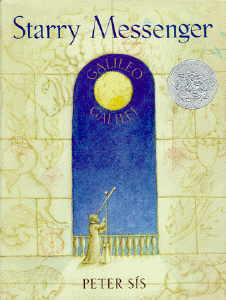
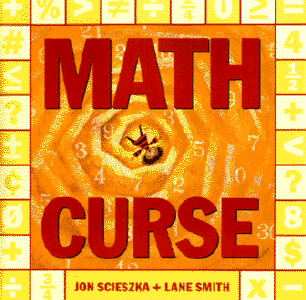
A wonderful reversal: adults are now acquiring children's literature. A growing number of smart, witty, lovely children's books are so well-made, adults often buy them as presents for other adults. They've replaced the art-and-architecture coffee table books in some homes.
part 2 (because you'll need this soon) how to analyze and write about literature
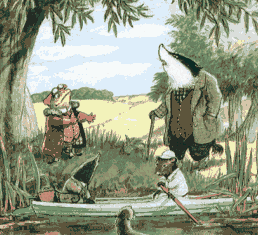
For this class you will not be writing about Kenneth Grahame's Wind in the Willows, but it's a very popular book (and a ride at Disneyland), and we can use it as an example.
The first, and many feel most difficult, task is to find something to write about.
You may be used to reading a story and writing a summary or a bit about the author or a review (thumbs up /thumbs down), but that will not do for this class; this is a class in literary analysis. That means you need to look at some significant idea or issue or theme or technique (I'd not recommend looking at technical elements of style unless you've got some solid background in analyzing fiction) of the work. Yes, I understand that this is a lot harder than just writing a plot summary, but analysis requires you to show your thinking (not your likes/dislikes) about a subject, your ability to find substance and thought in what you read. Analyzing a children's novel is the same task as analyzing Shakespeare's The Tempest or Fitzgerald's The Great Gatsby. You will need to develop a thesis, which means you will need some point to argue and support.
A thesis USUALLY is developed as an answer to a series of questions you ask yourself about the work (in this case, the book). After reading Wind in the Willows you might wonder:
Although Disney focuses primarily on the adventures of Mr. Toad, Grahame looks mainly at Mole; which one is the main character and why?
Why is the story called Wind in the Willows (originally Wind in the Reeds) and not The Adventures of Mr. Toad or The Adventures of Mr. Mole or both?
Both of these questions are excellent because they look at ideas that almost demand answers which are open to interpretation; they are not simple fact questions (such as what is the name of the horse pulling the caravan in the novel), and the answers will require looking at various parts of the novel for support. They require explanation, are open to debate, must be expanded on--all what you will need to develop a four-full-page (minimum) essay.
Here's the next step: look for answers to your questions; look for patterns in the book; eventually you should find some single area you can explore in a paper. Your thesis might be, for example,
Kenneth Grahame's Wind in the Willows is named for a force of nature rather than a single character because, on one level, the book is about the power and beauty of nature versus the decay and chaos of industry and technology.
Yes, this is a long sentence. You WANT a long and very-specific (focused) sentence that clearly states an idea that (and here I'll repeat myself) requires explanation and expansion, that requires examples from the book for support. The thesis does something elss; it determines what will or will not be in your paper. For example, a long discussion of Toad as a washer woman doesn't really have anything to do with this thesis. Looking at Toad causing chaos with his motor car, however, does fit this thesis because it's an example of the "decay" that the automobile has caused to the quiet villages and landscapes, and the automobile clearly represents "industry and technology."
So at this point you can consider what bits of the book relate to your argument (notice that a thesis is an argument; it's a claim that something very specific it being suggested by the book). You can/should go back through the book and note passages that you will want to quote as you develop your paper on this one key idea. I hope you take good notes when you read the works :)
There are several sections in the novel which show the ugliness of the now-polluted cities versus the simple (and sometimes sublime) loveliness of nature. Nature is seen as a restorative; technology (Toad's boat, cars, etc.) are seen as trouble. After you build up a healthy list of examples, you'll craft your essay using the observation-quotation-explanation method; in essence, you will make some statements (your observations), back them up with examples (documented quotations from the text), and discuss how they develop your thesis (explain them in relation to the point of the paragraph or to the point of your essay as a whole). Here's an example of a very small section of this paper:
In the "Badger" chapter, the characters come across elaborate ruins of some earlier human civilization. Badger comments, "'People come--they stay for a while, they flourish, they build--and they go. It is their way. But we remain. There were badgers here, I've been told, long before the same city ever came to be. And now there are badgers here again. We are an enduring lot, and we may move out for a time, but we wait, and are patient, and back we come. And so it will ever be"' (Grahame 129). Here the permanence of nature is shown in sharp contrast to the rise and decay of human civilization, development, technology.
Mainly, you want to stay away from simple biography and plot summary. You are trying to look for ideas and issues in the works you read. The days of book reports are long past.
And do make sure they are your ideas and observations. Do not use SparkNotes or LitCharts or ChatGPT to read and think for you. If there is some reason to quote an outside source (in addition to the work you are writing about, then you will want to also have an MLA 9 format Works Cited, but these papers really will not often require that.
Following is a link to an excerpt from a student paper in the B+/A- range. It is not technically perfect, but it is a clear. focused analysis of a single idea in a novel, and it is supported with lots of documented quotations from the novel Cirque du Freak (this was for Writing Assignment 2). Take a look so that you have another idea of what analysis is all about:
![[course schedule]](button31s.gif)
![[discussion questions]](button31q.gif)
![[lectures]](button31l.gif)
![[writing assignments]](button31p.gif)
![[readings]](button31r.gif)
![[home]](button31h.gif)