"Our Barbies, Ourselves," "Barbie, G.I. Joe, and Play in the 60s," and "Love is a Fallacy"
This week's discussion is different; it's more of a share week than a discussion. You are not even required to respond to other posts, though you certainly may.
Read through the two assignments below carefully; there are several parts and restrictions. If you miss part of the assignment then you will not earn full points.
You will choose just one of the following two assignments:
1. Barbies Assignment
An argument is only as good as the evidence on which it is based.
The two articles "Our Barbies, Ourselves," and "Barbie, G.I. Joe and Play in the 1960s" are seemingly fact-filled pieces about popular toys; however, they disagree on one significant point. In "Our Barbies, Ourselves" Prager states that the Barbie doll was invented by a man, Jack Ryan. In "Barbie, G.I. Joe and Play in the 1960's" Gary Cross states that Barbie was the creation of a woman, Ruth Handler. What's the diffrence? How does this point affect the credibility of what each author is trying to argue?
Now, what does the evidence actually say? Look up at least one "credible" source giving the history of Barbie and its creation. First, establish just why your source is authoritative, qualified, "credible." Clearly a personal blog site will not be as credible as a book on the subject or as an article written for The Wall Street Journal by a well-known culture historian. So you do not want to just pick the first thing you see in a Google search. Evaluate the source. Then, quoting some passages from the source, explain who actually did come up with the idea? What were the roles of Handler and Ryan in the project?
What does this contradiction say about what people often consider to be facts? Is there stereotyping in these articles? If so, where?
Feel free to look into the backgrounds of Prager and Cross as well. You might discover some things that make one or the other article "feel" more authentic and less personal.
After you then evaluate which of the two articles has more credence, you may also want to add other examples of things you were taught were factual but which you later learned were untrue (I'm not talking about belief in Santa or the Easter Bunny--both are, of course, real; instead, I am talking about things we've read or seen on the news or been taught in classes or read in textbooks).
Beware! Don't you fall into the trap of stereotyping with this discussion. Use actual examples. If you played with Barbie or GI Joe when you were younger, did it have a significant impact on your own life? Did Barbie make you think of sex and give you low self-esteem, or was she just fun to dress up?
NOTE: this discussion will require a little bit of research, and I would like you all to share that research (the easiest way is by adding a link in your posting). Canvas has a Link icon that is easy to use: you highlight some text in your discussion (maybe the name of the site you are linking to), click the Link icon, then copy the URL of the site you would like the class to visit. If you see the same link going up in several postings, find other sources; do not just copy what others have found. There are many sources on the history of Barbie online and in print.
2. Fallacies Assignment
We've looked at what constitutes evidence, and you've read about fallacies in "Love is a Fallacy." Now you are going on a fallacy hunt. This is actually very easy since you can search the internet for some of your examples. You are going to be posting links or copying/pasting ads in your discussion this week as well as writing about fallacies. Here's what you'll do:
IMPORTANT NOTE: for this assignment the examples must be new, within the past few years. I know there are many websites with old ads showing people like Marilyn Monroe smoking; I also know those sites explain these fallacies for you. I want you do be able to demonstrate your own thinking, and I want you to show the relevance of this assignment by showing current examples. If you submit old ads, you will not earn credit for the first 12 points of this exercise.
(10 points) find two print fallacies or advertisement fallacies and copy them into the Discussion area on Canvas (explained above).
(10 points) explain at least one fallacy being used in each of your examples
Here are a couple of examples that should give you the idea of what we are doing (be sure to ask if you are unsure):
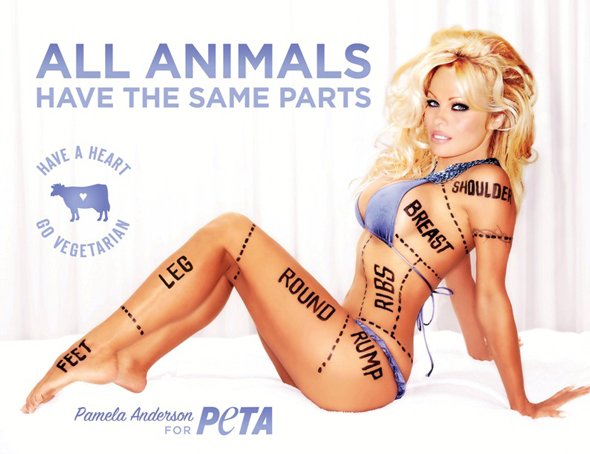
This image, part of the PETA campaign, has a number of fallacies: 1) it is using sex appeal to sell its position; 2) it is using a testimonial (Pamela Anderson is a celebrity) to encourage people to identify with the position; 3) it is makeing a false analogy (here humans are being compared to cattle or sheep or pigs); 4) it is overly general (not all animals have the same parts; people and horses, for example, do not have mandibles or claws or antennae).

Another PETA ad uses 1) emotionallly-charged words ("child abuse"); 2) it over-generalizes (assuming that all obesity is caused by eating meat and that all meat eaters will become obese); the third falsity (not the same as fallacy) in this ad is the camera distortion that shows the hamburger roughly as large as the young man's head and gives the man huge jowls).
Note about putting the assignment on Canvas: you can easily copy/paste the ads onto Canvas and then write about them (and then write your own examples), but there is a bit of a trick. First, find the ads you want to write about on the Web (that will certainly not be hard); second, put your cursor over the ad/image and right click/COPY; third, open the New Topic area in Discussion 3, put your cursor in the message area, and paste by holding down CTRL-V (at the same time). Then write about them. If you wish to use YouTube ads (rather than static print ads), you may, but you would then want to EMBED them on the message area of Canvas (there is an embed button, and you can copy the embed information on YouTube) or provide a link to the clip.
![[101 home]](btnxanim.gif)
![[class schedule]](btnhour.jpg)
![[homework]](btnhwrk.jpg)
![[lectures]](btnhipi.jpg)